
History · Typewriters
Typewriters: The Art of Mechanical Writing
The typewriter belongs to an era when writing was an art, when every keystroke carried weight, and when each page told its story through the rhythm of striking typebars. Before the digital age, these mechanical machines made writing faster, more uniform and widely accessible.
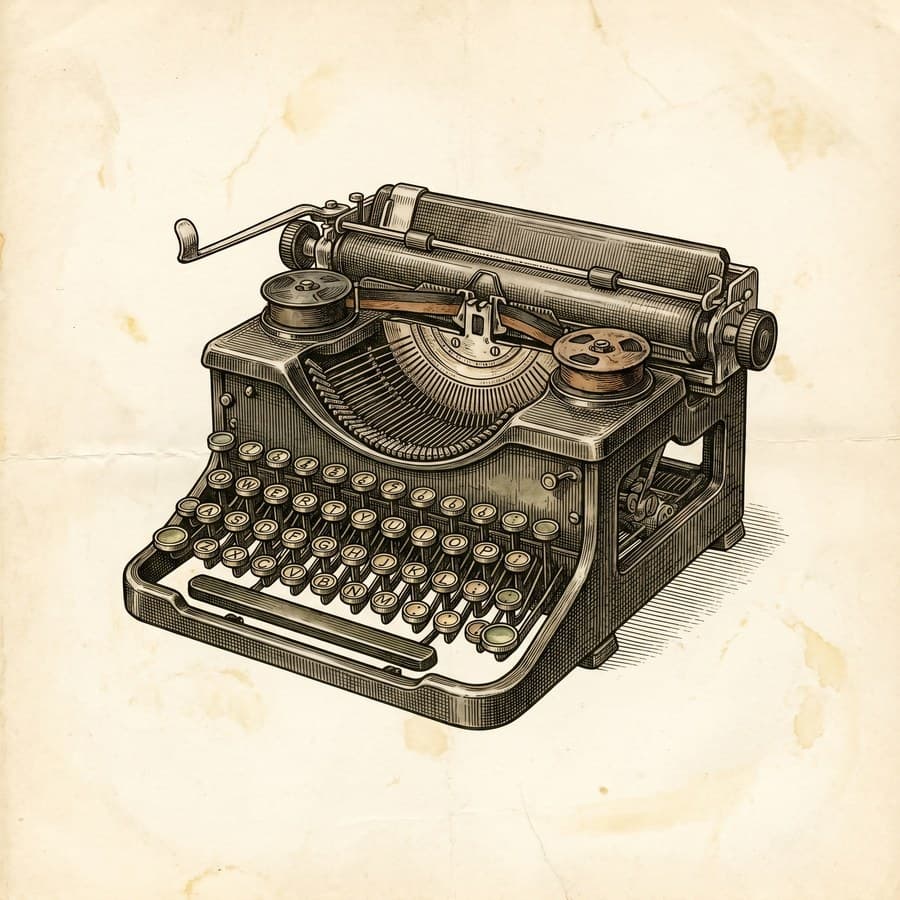
The origins: the birth of the typewriter
The history of the typewriter reaches back to the early nineteenth century, as inventors around the world tried to build a machine that could produce uniform text. It was Christopher Latham Sholes who, in 1868, developed the first commercially successful typewriter, later known as the Remington No. 1. This model introduced the QWERTY layout that is still standard today.
Sholes is credited with popularising the typewriter, but earlier prototypes paved the way — among them work by Pellegrino Turri, who built a machine for a blind friend, and by William Austin Burt.
The typewriter quickly became essential for offices, writers and journalists, changing how people recorded and shared information.
Innovation and evolution
Early mechanical typewriters (1870s–1920s) — The first mass-produced machines used manual key actuation: pressing a key drove a typebar against an inked ribbon.
Standardised office typewriters (1920s–1950s) — Underwood, Remington and Royal refined the design with front-strike mechanisms, so typists could see their work as they typed.
Portable typewriters (1930s–1970s) — Compact, lightweight models from brands such as Smith-Corona, Hermes and Olivetti suited journalists, students and writers on the move.
Electric typewriters (1950s–1980s) — IBM and Smith-Corona replaced the mechanical key strike with a motorised system, reducing finger fatigue and increasing typing speed.
Daisy wheel and electronic typewriters (1970s–1990s) — These introduced daisy wheel printing, memory storage and correction features, bridging the gap to the early computer.
Cultural impact and usage
- Literature — writers such as Ernest Hemingway, Agatha Christie and Hunter S. Thompson relied on typewriters to craft their work.
- Journalism — before computers, newsrooms ran on the clatter of typewriters racing to meet deadlines.
- Business — offices used typewriters for correspondence, invoices and record-keeping.
- Pop culture — the typewriter became a symbol of nostalgia, featured in films and television.
A few facts
- Mark Twain was among the first authors to submit a typewritten manuscript — The Adventures of Tom Sawyer.
- The QWERTY layout, designed for typewriters, is still the standard keyboard layout today.
- The word “typewriter” can be typed using only the top row of a QWERTY keyboard.
Why typewriters still matter
Computers have largely replaced typewriters, but these machines are still loved for their tactile feel, their nostalgic charm and the focused, distraction-free writing they encourage.