
History · Cassette Players
Cassette Players: The Portable Sound Revolution
Cassette players changed how people listened to music, offering portability, personalisation and accessibility like never before. From mixtapes to the Walkman, they became part of pop culture.
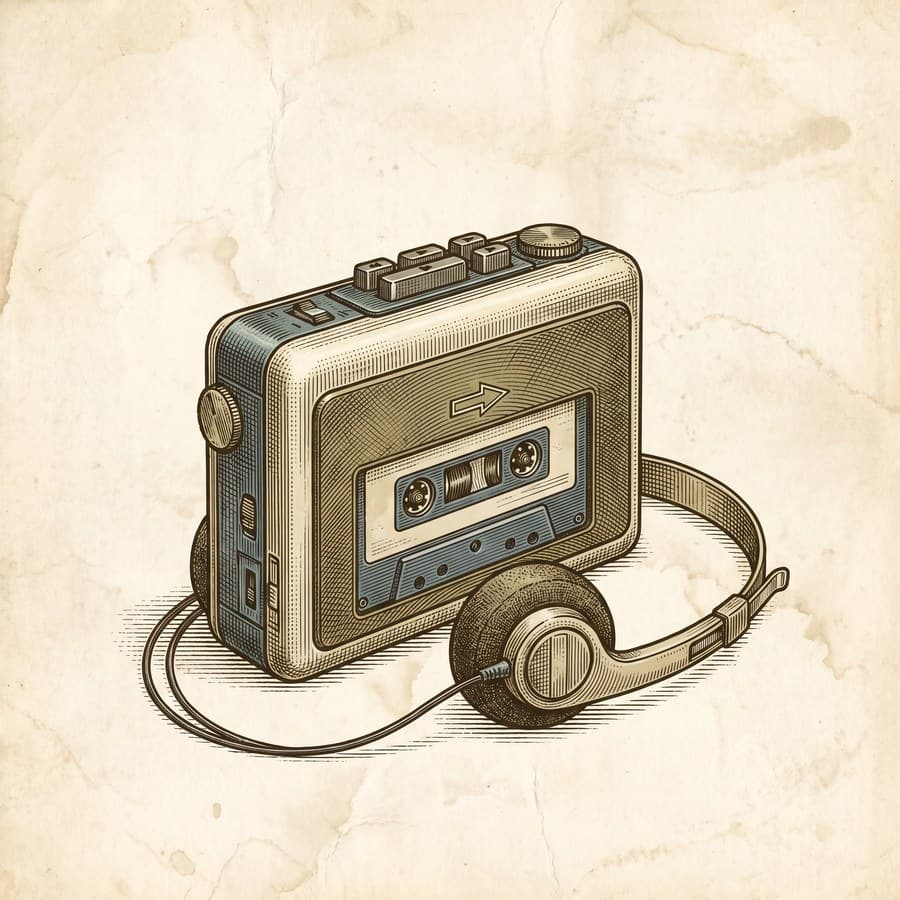
The origins: the birth of cassette technology
Cassette players begin with the compact cassette, introduced by Philips in 1963. It was first designed for voice recording, but its low cost and ease of use quickly made it a music format.
Fritz Pfleumer had developed the first magnetic tape recording technology back in the 1920s. Sony’s 1979 Walkman made music truly portable for the first time, and by the 1980s the cassette player was a global phenomenon.
Innovation and evolution
Reel-to-reel tape recorders (1940s–1960s) — Before compact cassettes, reel-to-reel machines handled recording and playback — high quality, but bulky and expensive.
Compact cassette players (1960s–1970s) — Small, enclosed cassettes brought recording and listening to everyday consumers, and made the personal mixtape possible.
The Walkman era (1979–1990s) — Sony’s Walkman — lightweight, battery-powered and built for headphones — gave rise to personal, on-the-go listening.
Boom boxes and car stereos (1980s–1990s) — Large, speaker-equipped players became symbols of urban music culture, with dual speakers and AM/FM radio.
Dual-deck cassette players (1980s–1990s) — Two cassette slots let users copy tapes and build their own compilations.
Decline and resurgence (2000s onward) — CDs and streaming pushed cassettes aside, but a nostalgia-driven revival has brought them back into niche markets.
Cultural impact and usage
- Mixtape culture — people made mixtapes as heartfelt gifts.
- A personal music experience — the Walkman let individuals control their own listening for the first time.
- Radio recording — listeners could record songs straight from the radio.
- Hip-hop and street culture — the boom box became a defining feature of 1980s hip-hop.
A few facts
- The first Walkman, the Sony TPS-L2, was released in 1979.
- Cassettes outsold vinyl records for the first time in 1983.
- Many modern artists still release albums on cassette as collector’s items.
Why cassette players still matter
Even in the digital age, cassette players evoke a real sense of nostalgia and an appreciation for analogue sound.