
History · Telephones
Telephones: Revolutionising Communication
The telephone is one of the most transformative inventions in human history. It redefined how people connect across distances, shrinking the world and making real-time communication possible. From rough prototypes to sleek smartphones, the story of the telephone is one of ingenuity and persistence.
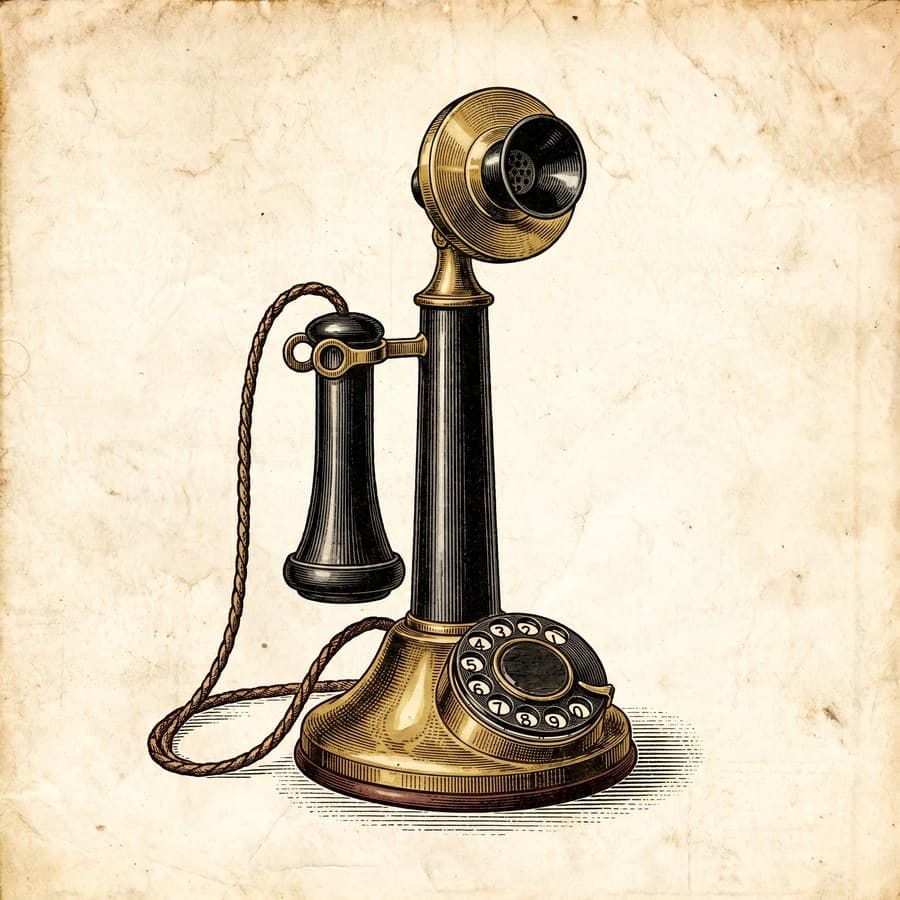
The origins: Alexander Graham Bell and the first call
In 1876, Alexander Graham Bell patented the first practical telephone. His work was inspired by his experience with the hearing impaired and his experiments with harmonic telegraphy. His first words down the line — “Mr. Watson, come here, I want to see you” — marked the first successful voice transmission.
Bell is widely credited as the inventor, but others contributed to early telephonic technology. Elisha Gray worked on similar ideas, and Antonio Meucci demonstrated a voice communication device years before Bell’s patent.
Early telephones were simple devices that used wires and electricity to transmit sound, connected to a manually operated central switchboard. It was the dawn of telecommunication.
Innovation and evolution
Candlestick telephones (1880s–1920s) — Named for their slender shape, these had a separate mouthpiece and earpiece and were connected by an operator who routed calls by hand.
Rotary dial telephones (1891–1960s) — Almon Strowger’s rotary dial removed the need for an operator — users dialled numbers directly through mechanical switching.
Push-button telephones (1963–1980s) — Introduced by Bell Systems, the push-button phone replaced the dial with a keypad and Touch-Tone signalling for faster routing.
Cordless telephones (1980s–1990s) — Cordless phones used radio frequencies between handset and base, freeing users to move around the home or office during a call.
Mobile phones (1990s onward) — The shift from landlines began with bulky devices such as the Motorola DynaTAC 8000X in 1983. Advances in cellular technology made mobile phones widely accessible.
Smartphones (2007 onward) — The iPhone turned the phone into a multi-function device with internet access, apps and a camera.
Cultural impact and usage
- Business — telephones enabled faster decisions and real-time collaboration across distances.
- Personal connection — families and friends stayed close despite geography.
- Emergencies — the telephone became a lifeline during crises, enabling quick response.
- Globalisation — telecommunication opened the way for global business, diplomacy and cultural exchange.
A few facts
- The first telephone line, installed in 1877, ran three miles between Bell’s home and his workshop.
- In 1927, the first transatlantic call between London and New York cost 75 US dollars for three minutes.
- Landlines remain important in many regions, especially for reliability during power outages.
Why telephones still matter
Even with mobile devices everywhere, the telephone remains a symbol of human ingenuity and connection. It laid the foundation for modern communication and reminds us how far we have come in our wish to stay in touch.