
History · Cameras
Capturing Time Through Lenses
Cameras have changed the way we see the world. By freezing moments in time, they let us preserve memories, tell stories and document history. From the first experimental devices to today’s digital systems, the camera has evolved dramatically — a mirror of humanity’s pursuit of innovation and creativity.
The origins: the birth of photography
The story begins with the camera obscura, Latin for “dark chamber.” As early as the fourth century BCE, philosophers including Aristotle described this optical device, which projected an image of the outside world onto a flat surface through a small hole. It did not capture images, but it laid the groundwork for photography.
The breakthrough came in 1826, when the French inventor Joseph Nicéphore Niépce produced the world’s first photograph. Using a technique called heliography, he captured the view outside his window on a bitumen-coated plate — an image that needed an eight-hour exposure.
In 1839, Louis Daguerre introduced the daguerreotype, the first commercially viable photographic process. These silver-plated images were detailed and lifelike, and they made photography accessible to far more people.
Innovation and evolution
Box cameras (1888) — The Kodak No. 1, introduced by George Eastman, used roll film and a simple design. Eastman’s slogan, “You press the button, we do the rest,” put photography in the hands of amateurs.
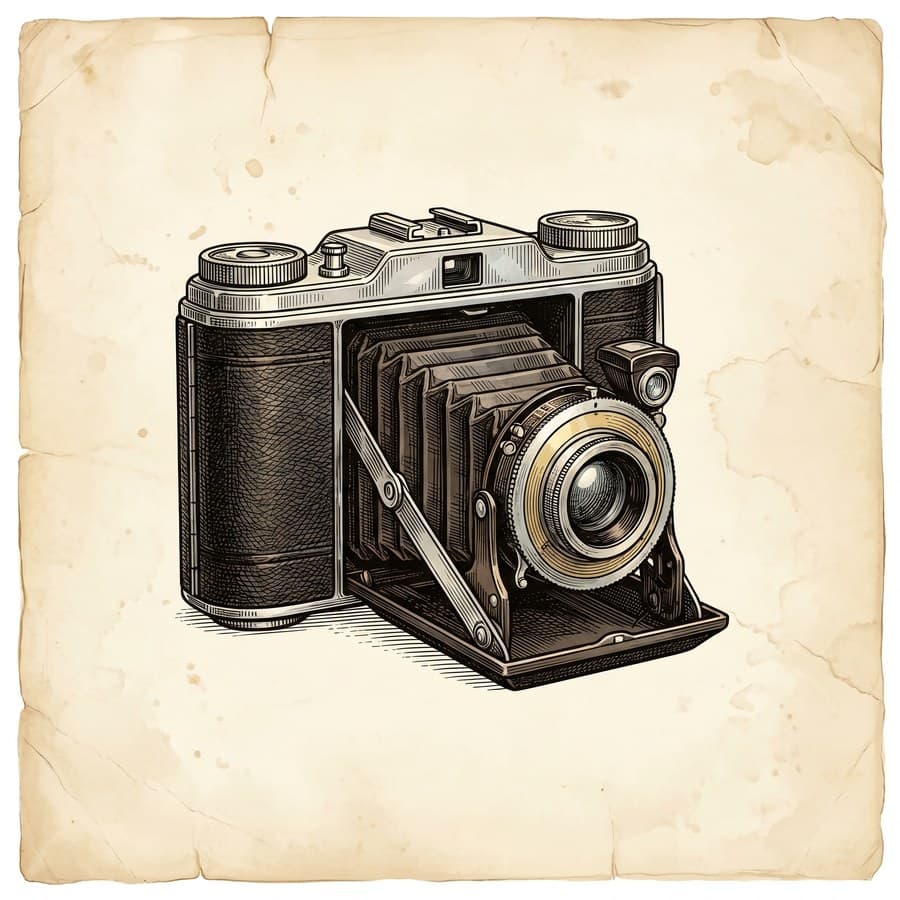
Folding cameras (1900s) — Compact and portable, with bellows that let users adjust focus. They were popular for outdoor photography.
Twin-lens reflex cameras (1920s) — TLR cameras used two lenses — one to view, one to capture — and offered excellent image quality. The Rolleiflex series is the famous example.
35mm film cameras (1930s) — 35mm film made cameras smaller, lighter and more versatile. Brands such as Leica popularised compact, high-quality cameras with interchangeable lenses.
Instant cameras (1948) — Polaroid cameras brought instant gratification: a self-developing print within minutes.
SLR and DSLR cameras (1950s onward) — Single-lens reflex cameras introduced precision focusing through mirrors; digital SLRs added digital sensors. Famous models include the Nikon F and the Canon EOS series.
Mirrorless cameras (2010s onward) — By removing the bulky mirror of a DSLR, mirrorless cameras became lighter and faster while keeping comparable quality.
Smartphone cameras (2007 onward) — With the iPhone, the camera became something everyone carries. Multiple lenses and advanced image processing made photography universally accessible.
Beyond memories: how cameras are used
- Historical documentation — from wars to social movements, cameras have captured the moments that shaped history.
- Artistic expression — photography became a celebrated art form, blending creativity with technology.
- Science and exploration — cameras have enabled discoveries from microscopic imaging to distant galaxies.
- Personal memories — cameras preserve milestones and tell personal stories in pictures.
A few facts
- The first photograph to include a person was taken by Louis Daguerre in 1838.
- The first digital camera, built by Kodak in 1975, captured images at a resolution of 0.01 megapixels.
- A Leica 0-series camera sold at auction for 2.96 million US dollars in 2012.
Why cameras still matter
Cameras remain one of our most powerful tools for storytelling. From personal memories to world events, they let us share perspectives, preserve moments and explore the beauty of life.