
For schools
Antique Education Tours
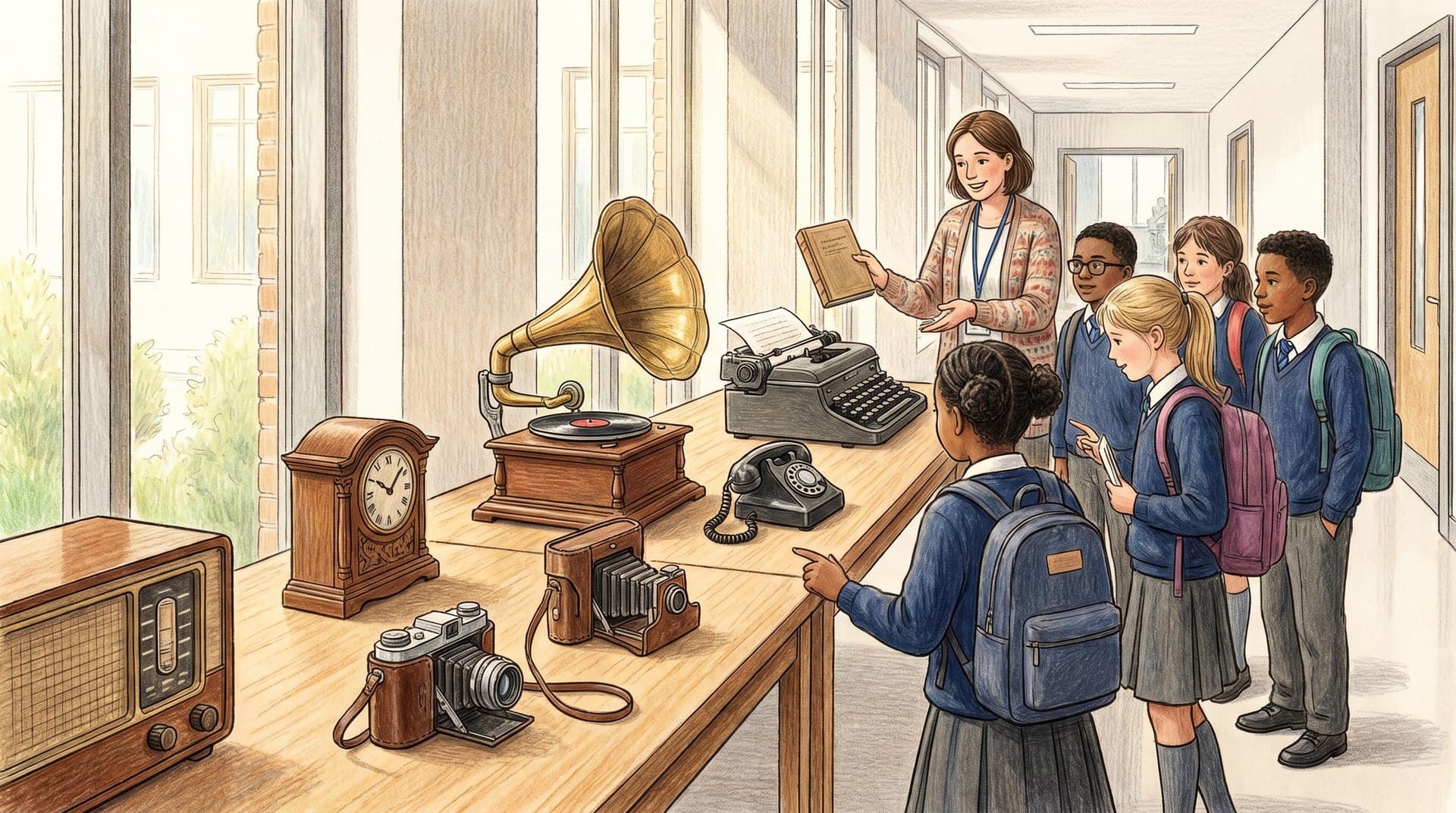
We bring real antique telephones, typewriters, cameras and gramophones into your school, so students can see, hear and handle the technology their great-grandparents used — and understand how the devices they carry today came to be.
What students experience
Most children have never dialled a number, wound a gramophone or loaded a roll of film. In an Antique Education Tour they do, under our supervision, with genuine pieces rather than replicas or pictures on a screen.
- Telephones. Turning a rotary dial and feeling how it clicks back, then learning that each click is a pulse that once moved a switch in a telephone exchange.
- Typewriters. Typing their own name on a mechanical typewriter: watching the typebar strike the ribbon, hearing the bell at the end of the line and returning the carriage by hand.
- Cameras. Looking through the viewfinder of a folding or box camera, seeing how the bellows and lens focus light, and discovering why every photograph used to be precious.
- Gramophones. Winding a gramophone, setting the needle in the groove and hearing music made with no electricity at all — just a spring, a needle and a horn.
Depending on what is available for your visit, a session can also include radios, clocks, projectors, cassette players and records.
How everyday technology evolved
Each object is a step in a story students already know the ending of. The telephone on the table leads to the phone in their pocket; the typewriter's QWERTY layout is the one on their school computer; the film camera explains why we still talk about "shooting" a photo. Seeing the earlier steps makes the present easier to understand — and makes it easier to imagine what comes next.
How a visit works
- Tell us what you have in mind. Use the form on this page or message us on WhatsApp with the age group, roughly how many students, and a few possible dates.
- We plan it together. We call to agree the date, timings and format — a talk for a whole year group, sessions class by class, or a small exhibition that classes visit in turn — and the topics you would like us to link to.
- We set up before the first session. All we need is a classroom, hall or library with a few tables.
- The session. A short introduction to each object, live demonstrations, and then supervised hands-on time in small groups, with plenty of room for questions.
- Afterwards. We are happy to suggest questions and activities to carry the discussion back into the classroom.
Age groups and curriculum links
We shape each session to the age of the students: simple wonder and "what does this do?" for the youngest; mechanisms, materials and social history for older students. Sessions can support topics in your syllabus whichever board you follow, for example:
- History and social science — change over time, daily life in the twentieth century, how communication and entertainment shaped society, and handling objects as primary sources.
- Science — sound and vibration (gramophones, telephones), light and lenses (cameras, projectors), springs, gears and levers (typewriters, clocks), and simple electrical circuits.
- Design and technology — materials such as Bakelite, brass, steel and wood; how products were designed to be used, repaired and manufactured; and why designs changed.
- Languages and the arts — writing on a typewriter, describing an object in detail, and creative writing inspired by the past.
Care and safety
- Every hands-on moment is supervised by us, and we show students how to hold and use each piece before they touch it.
- Pieces with glass, sharp edges or delicate parts are demonstrated by us rather than passed around.
- Nothing is connected to mains electricity during a session.
- We check every piece before a visit, and we ask students to have clean, dry hands — antiques are sturdier than they look, but they have survived this long because people looked after them.
Practical details
- Where. Schools in and around Bengaluru. Further afield is possible by arrangement.
- Timings. A session can fit a single period or run across a morning, with classes rotating so every student has hands-on time.
- Space. A classroom, hall or library with a few tables.
- Cost. We will quote once we know the date, numbers and format.
Book a visit
Request an Antique Education Tour
Tell us a little about your school and the students, and we will call to plan the visit with you. There is no obligation until we have agreed the details together.
Or talk to us directly: WhatsApp · +91 63636 13135